












Choosing a crypto wallet is partly about security and partly about how you plan to use your cryptocurrency. Someone holding Bitcoin for the long term may have different priorities from a person who regularly sends, receives or trades digital assets.
There is no single wallet that is the best choice for everyone. Hardware wallets, mobile wallets, desktop applications and custodial exchange wallets each make different trade-offs between convenience, control and security.
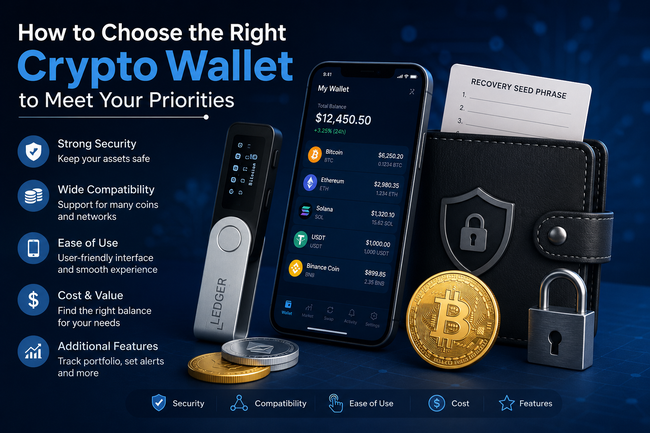
Before choosing one, it is worth comparing the networks it supports, how private keys are managed, its recovery process and the features you are likely to use.
Check wallet compatibility
Start by checking whether the wallet supports the cryptocurrencies and networks you intend to use. A Bitcoin-only user may prefer a wallet focused specifically on BTC, while someone who holds assets across several blockchains may want broader network support.
Network compatibility matters as much as the name of the coin. Sending an asset over an unsupported network can create unnecessary complications, so the wallet's documentation should be checked before transferring funds.
Review the security model
A wallet's security should be judged by how it protects access to funds and how much control the user has over the private keys.
- Check whether the wallet is custodial or non-custodial.
- Use two-factor authentication when the service supports it.
- Protect the recovery phrase or other recovery credentials offline.
- Keep wallet software and device firmware updated.
- Download wallet applications only from their official sources.
Hardware wallets keep signing keys away from a normal internet-connected computer and can be useful for people storing larger amounts for longer periods. Software wallets can be more convenient for frequent transactions, but users should still pay close attention to device security and backups.
There are many different products available. For another overview of Bitcoin wallet choices, see the Bitcoin wallet guide from BitEdge.
Compare costs
Many software wallets can be downloaded without an upfront purchase, while hardware wallets require a physical device. Price alone should not determine the choice: the more important question is whether the wallet's security model and features are appropriate for the amount and type of cryptocurrency being stored.
Transaction fees are also separate from the price of the wallet itself. Bitcoin and other blockchain networks may charge network fees when funds are sent, regardless of whether the wallet application was free or paid.
Look at the recovery process
Before depositing a significant amount, understand what would happen if the phone, computer or hardware wallet was lost or damaged. A non-custodial wallet will usually provide a recovery method that must be stored securely by the user.
Never provide a seed phrase, private key or recovery credential to a website or person claiming they need it to check a transaction. Anyone with those credentials may be able to control the funds.
Consider additional features
Depending on how the wallet will be used, features such as portfolio tracking, address books, QR-code support, fee controls and price notifications may be useful.
Some wallets include built-in conversion tools. If one is not available, an independent service such as the CoinGecko cryptocurrency converter can be used to compare approximate market values.
Choose according to how you use crypto
A wallet used for small everyday transactions does not necessarily need to be the same wallet used for long-term storage. Some users separate spending funds from larger holdings so that convenience does not come at the expense of their main storage security.
Whichever approach you choose, verify the wallet's official website, understand who controls the private keys and test the recovery process before relying on it for a significant amount of cryptocurrency.